While in Cottbus, we stayed with John's host family. When I had met them a few years ago, neither of the parents spoke any English. Now they speak a little bit of English. For the first couple days, they tried to speak in English to me but we had quite a few miscommunications. Then they just spoke German and John translated every now and then.
During the visit, I tended to "tune out" when John was talking to the family. I watched their facial expressions, gestures, and other non-verbal signs to try to get the general meaning of the conversations. Sometimes I did, sometimes I didn't. When I couldn't get the general meaning or people seemed in deep conversation, I just tuned out, thought my own thoughts, or watched them talk. I was frequently reminded of a study that I frequently quote when giving presentations on the importance of visual information for people with communication difficulties. The study, done in 1998, found that only 7% of meaning is in the actual words said. That means that 93% of meaning is derived from visuals and other factors such as they way things are said (voice volume, tone of voice, prosody, etc).
By the end of the visit, people commented that I seemed to understand their conversations quite well. However, I don't think I did. I just tuned into the 93% of the meaning, laughed when others laughed, and mirrored their facial expressions. That made them think that I understood the actual language said.
This experience made me wonder if this is a part of what my clients/students experience. At first, I felt frustrated and utterly confused at not being able to understand the language. Then I just tuned out. Then I watched for other cues. If we had stayed longer, I probably would have understood more (but I kept thinking in Spanish). But then, I probably would have gotten more frustrated at times as well. And at least I had a translator to explain things to me. It is no wonder that some of my clients display challenging behaviour.
What I found most interesting was that my communication partners highly overestimated my comprehension of German. I also find that happens in disability. People associate overall language comprehension with social skills. If a person is social and able to negotiate a social situation/have a conversation, then they think they understand other things/everything. However, this is not always the case.
Showing posts with label disability issues. Show all posts
Showing posts with label disability issues. Show all posts
Tuesday, August 14, 2007

Thursday, June 14, 2007
Friday, May 11, 2007
Symbols
Recently, I have been pondering about symbols and how humans create them and give them meaning. Language is symbolic and arbitrary. How did someone decide that a chair is a chair and not a lala? It is all arbitrary. Well, except onomatopoeia.
For most of us, the symbols of language come naturally. We hear the sounds in our language and from a few months old, we start to respond differently to speech than other sounds. As infants, we also respon differently to sounds in the native tongue than those of a foreign language. We then tune in even more and say our first words usually about 12 months. From that age, language development sky rockets until about 6 when most of language has been acquired. So, in 6 short years, people have a pretty good command of their language. Their abstract, arbitrary symbol set.
But then there are other symbols. These are also arbitrary as well, I think that is part of the meaning of it being a symbol. These, like language, are often cultural and vary in different places in the world. However, they still exist. What is it about humanity that we need these symbols? How did people decide that a ring symbolizes commitment between two people? The way to wear the ring may change in different cultures but the symbolism is still there. How did people decide that marriage is important? Why do humans create these extra meanings and ceremonies?
The other piece of this is how much people with communication difficulties miss. They may learn basics, but they often don't learn the subtlies of interactions. The delicate balance that is inate for most of us has to be taught and it is very difficult to teach all these unwritten rules for interactions and symbol sets.
For most of us, the symbols of language come naturally. We hear the sounds in our language and from a few months old, we start to respond differently to speech than other sounds. As infants, we also respon differently to sounds in the native tongue than those of a foreign language. We then tune in even more and say our first words usually about 12 months. From that age, language development sky rockets until about 6 when most of language has been acquired. So, in 6 short years, people have a pretty good command of their language. Their abstract, arbitrary symbol set.
But then there are other symbols. These are also arbitrary as well, I think that is part of the meaning of it being a symbol. These, like language, are often cultural and vary in different places in the world. However, they still exist. What is it about humanity that we need these symbols? How did people decide that a ring symbolizes commitment between two people? The way to wear the ring may change in different cultures but the symbolism is still there. How did people decide that marriage is important? Why do humans create these extra meanings and ceremonies?
The other piece of this is how much people with communication difficulties miss. They may learn basics, but they often don't learn the subtlies of interactions. The delicate balance that is inate for most of us has to be taught and it is very difficult to teach all these unwritten rules for interactions and symbol sets.
Tuesday, May 01, 2007
Blogging against disabilism
Today is blogging against disabilism. I found by checking Dream Mom and the family voyage blogs. The family voyage linked to Diary of a Goldfish who started the day with another blogger last year.
So, in honor of the day, I will write today what I was planning on writing another day. I had a professional development day. It is actually the second recently which is quite nice. Anyway, today was a road show sponsored by Communication Matters which is the UK chapter of the International Society for Alternative Augmentative Communication (ISAAC). It is always nice to go to these presentations because you can hear from the vendors, play with devices and get ideas for therapy. Today, the vendors each did 20 minute presentations and you could pick which one you wanted to go to. It was interesting to hear about a couple devices that I had not heard of before and learned some stuff about some new features on devices/software I already know well. And I was able to hear the questions other people asked.
I also quite like these days because I really enjoy talking to vendors. It is interesting to me to see which ones "get it" and which ones don't. Many of the vendors are not speech therapists. A couple are and a couple used to be teachers but you can tell which ones have a language background and which ones don't. I think this may actually be part of the difficulty with AAC.
I have been working as a "speechie" for 8 years now and I feel like I am finally "getting" AAC. I have had many failures where the clients abandoned the system. It is frustrating because it is usually the communication partners and the vocabulary programmed that makes it fail. It is not the people using the devices. AAC takes a lot of time and effort on the part of the communication partners and you need people (or at least one person) who has an idea as to how to set up devices. When I took my AAC class in graduate school, I learned some theories but I didn't learn the practical stuff. I didn't really think about what language we speaking people use. I now think about that. I listen to the peers in the classroom. I listen to the teacher and that vocabulary. I have also done A LOT of continuing education in the area since it is a fast-changing area in the field.
Today at the road show, every single vendor demonstrated ultra polite speech such as "I would like ice cream." Who talks like that? Certainly not me. I say, "I want ice cream" or "I fancy an ice cream" or "hey, let's eat some ice cream" or some other way. I never use the ultra polite grammar. And yet, that is what people typically put on their clients/students AAC devices. Why should they be more polite than the rest of us?
When at a conference, I went to a discussion group on swearing led by a person who uses AAC. She was advocating for her right to have foul language put onto her device. Many people in the room were against having actual swearing on devices. We also discussed the need to put milder "bad" language on younger children's devices. Kids call each other "potty face" or things like it. Why shouldn't an AAC user?
The answer is usually that the communication partners aren't comfortable with that idea. People see someone who can't talk differently. They aren't exposed to the same social situations so they don't learn the social skills such as who you can call a "potty face" and who you can't. Also, people aren't comfortable reprimanding an AAC user the same way as a speaking child. They take the device away instead. I have had teachers erase the "I'm bored" button on their students devices. And yet, it is exactly this type of vocabulary that the children need. They need to be able to explore language and learn the social rules of conversation and interaction. Keeping them ultra-polite does not prepare them for the insensitive speakers they are going to encounter. It doesn't prepare them to interact with people who have no idea how to interact with an AAC user. It just keeps them socially inexperienced.
So, in honor of the day, I will write today what I was planning on writing another day. I had a professional development day. It is actually the second recently which is quite nice. Anyway, today was a road show sponsored by Communication Matters which is the UK chapter of the International Society for Alternative Augmentative Communication (ISAAC). It is always nice to go to these presentations because you can hear from the vendors, play with devices and get ideas for therapy. Today, the vendors each did 20 minute presentations and you could pick which one you wanted to go to. It was interesting to hear about a couple devices that I had not heard of before and learned some stuff about some new features on devices/software I already know well. And I was able to hear the questions other people asked.
I also quite like these days because I really enjoy talking to vendors. It is interesting to me to see which ones "get it" and which ones don't. Many of the vendors are not speech therapists. A couple are and a couple used to be teachers but you can tell which ones have a language background and which ones don't. I think this may actually be part of the difficulty with AAC.
I have been working as a "speechie" for 8 years now and I feel like I am finally "getting" AAC. I have had many failures where the clients abandoned the system. It is frustrating because it is usually the communication partners and the vocabulary programmed that makes it fail. It is not the people using the devices. AAC takes a lot of time and effort on the part of the communication partners and you need people (or at least one person) who has an idea as to how to set up devices. When I took my AAC class in graduate school, I learned some theories but I didn't learn the practical stuff. I didn't really think about what language we speaking people use. I now think about that. I listen to the peers in the classroom. I listen to the teacher and that vocabulary. I have also done A LOT of continuing education in the area since it is a fast-changing area in the field.
Today at the road show, every single vendor demonstrated ultra polite speech such as "I would like ice cream." Who talks like that? Certainly not me. I say, "I want ice cream" or "I fancy an ice cream" or "hey, let's eat some ice cream" or some other way. I never use the ultra polite grammar. And yet, that is what people typically put on their clients/students AAC devices. Why should they be more polite than the rest of us?
When at a conference, I went to a discussion group on swearing led by a person who uses AAC. She was advocating for her right to have foul language put onto her device. Many people in the room were against having actual swearing on devices. We also discussed the need to put milder "bad" language on younger children's devices. Kids call each other "potty face" or things like it. Why shouldn't an AAC user?
The answer is usually that the communication partners aren't comfortable with that idea. People see someone who can't talk differently. They aren't exposed to the same social situations so they don't learn the social skills such as who you can call a "potty face" and who you can't. Also, people aren't comfortable reprimanding an AAC user the same way as a speaking child. They take the device away instead. I have had teachers erase the "I'm bored" button on their students devices. And yet, it is exactly this type of vocabulary that the children need. They need to be able to explore language and learn the social rules of conversation and interaction. Keeping them ultra-polite does not prepare them for the insensitive speakers they are going to encounter. It doesn't prepare them to interact with people who have no idea how to interact with an AAC user. It just keeps them socially inexperienced.
Friday, April 27, 2007
Feedback
I think everyone needs to hear how they are doing on the job. In many jobs, people hear if they aren't doing things well. I think managers have more difficulty saying when people are doing a good job. Sometimes people really need to hear, "wow, great job on that." Well, and feel like it is sincere as well. :)
Some jobs have a lot of extrinsic rewards and praise. Others have more intrinsic rewards. Speech/Language therapy is a profession with intrinsic rewards. We get paid a livable wage but it isn't stellar. We are supposed to be motivated by the feel good factor or our patients/clients/students making progress and knowing that we are helping people. However, when working with people with severe/profound cognitive impairment, the progress is smaller and can be difficult to see at times. Therefore, it can be harder to get that feedback and intrinsic reward. I think that is part of why the field of cognitive impairment has such a high burn out rate. However, when someone does something for the first time, that really is the feedback that makes me happiest.
Some jobs have a lot of extrinsic rewards and praise. Others have more intrinsic rewards. Speech/Language therapy is a profession with intrinsic rewards. We get paid a livable wage but it isn't stellar. We are supposed to be motivated by the feel good factor or our patients/clients/students making progress and knowing that we are helping people. However, when working with people with severe/profound cognitive impairment, the progress is smaller and can be difficult to see at times. Therefore, it can be harder to get that feedback and intrinsic reward. I think that is part of why the field of cognitive impairment has such a high burn out rate. However, when someone does something for the first time, that really is the feedback that makes me happiest.
Monday, January 29, 2007
Salaries
Recently, I had dinner with a couple friends. One, who is near retirement, happened to tell me how much she made. It was not very much more than I made even though she has been in the field more than 20 years longer than me! So, today I tried to log onto Impact's website to find the salary scale. Impact is the trade union that negotiates salaries (they probably do other things also). All speech therapists, Occupational Therapists, Physiotherapists are on the same salary scales and there are salary scales for various professions. However, I couldn't access the salary scales since you need to be a registered member to see how much you should be earning or have the probability to earn.
Anyway, since I couldn't get the information that way, I just looked on the job postings board for the physiotherapist ad since we are on the same salary scale. According to that posting, the salary scale tops out after 12 years! So, after working for 12 years you have no real raise potential until you retire unless you a)change careers, b) go into management, c) work for a private clinic. There is also a specialist post scheme intended to help income potential and recognize specialists in the field. However, there are only a few of these positions in the country and none of them are in intellectual disability.
So, when people ask me about attrition in the field, I now have a bit more of an idea why it is so high. Also, what incentive is there for expierence clinicians to stay in the public sector? How does the country benefit from capping salaries so early in our careers?
Anyway, since I couldn't get the information that way, I just looked on the job postings board for the physiotherapist ad since we are on the same salary scale. According to that posting, the salary scale tops out after 12 years! So, after working for 12 years you have no real raise potential until you retire unless you a)change careers, b) go into management, c) work for a private clinic. There is also a specialist post scheme intended to help income potential and recognize specialists in the field. However, there are only a few of these positions in the country and none of them are in intellectual disability.
So, when people ask me about attrition in the field, I now have a bit more of an idea why it is so high. Also, what incentive is there for expierence clinicians to stay in the public sector? How does the country benefit from capping salaries so early in our careers?
Sunday, January 07, 2007
Disability issues
I can't seem to stop thinking about the Ashley treatment and why her parents would do what they did. After making my last post, I realized that I may have missed it a bit. I shouldn't be outraged at Ashley's parents' actions (even though I am still processing it). Instead, these actions are a reflection of the society we live in.
There are a few larger issues that I think are well worth a lot of discussion and consciousness raising at the heart of the Ashley debate. First, the rights of people with disabilities. As I can see it, there are two sides to this debate. One saying that because Ashley has the cognitive abilities of an infant, she cannot make decisions about her body and therefore her parents have extra rights over her and that she herself loses rights that typically developing people would or wouldn't have (like who would give a typically developing healthy female and elective hysterectomy?). The other side says that all people, regardless of ability have certain civil rights and dignity which is inherent in being a human being.
I tend to fall in the camp of the second group. I strongly believe that all people, regardless of ability, have a personality, desires, etc. They may be at the pre-intentional level of communication but they are still a person. They still have basic rights. They still should be treated with dignity and respect. People should talk to them as if they understand. Because we don't know. We don't know what they know. We don't know what they understand. We just don't know and don't have a way of knowing at this time. Therefore, wouldn't it be better to error on the side of dignity than to assume they don't understand and to say derogatory things about them? What harm is it to use the term "depends" or "incontinence products" than nappies or diapers? Babies wear diapers or nappies, adults do not. I know this may seem like a small "language" or "PC" thing but language makes a difference.
The second issue is the difficulty of parenting a child with a severe/profound disability. As I have mentioned, supports are available to parents. However, they are often difficult to obtain. Unfortunately, funding for special needs devices is one of the first cuts made in government. The Irish government did not increase special education funding even though this funding is desperately needed and many were surprised by the lack in increased funding. Parents have to wait for a long time to get the devices they need and there are even longer waiting lists for in-home help. However, the government isn't providing additional funding. Even when there is funding, qualified people are often difficult to find.
While in college, I worked as a personal care assistant in clients' homes. I did a similar job while in graduate school. For both jobs, I got paid between 7-8 dollars an hour. For a student, that isn't bad money. If you are trying to do it to make a living and doing it full time, that isn't really a livable wage given that health insurance and taxes come out of that.
I guess the difficulties of parents is part of the larger issue of societal views of people with disabilities. There seems to be this automatic de-valuing of people with disabilities. There also seems to judgements made by appearance. When people see someone in a wheelchair, we make judgements. When we see someone with Down Syndrome, we again make judgements. The problem is that these judgements are often based on ignorance. Ignorance based upon a lack of interaction with people with disabilities. This lack of interaction is in turn caused by a lot of societal factors such as limited accessible spaces and a long history of "locking away" people with disabilities.
Ok, tirade done for now...
There are a few larger issues that I think are well worth a lot of discussion and consciousness raising at the heart of the Ashley debate. First, the rights of people with disabilities. As I can see it, there are two sides to this debate. One saying that because Ashley has the cognitive abilities of an infant, she cannot make decisions about her body and therefore her parents have extra rights over her and that she herself loses rights that typically developing people would or wouldn't have (like who would give a typically developing healthy female and elective hysterectomy?). The other side says that all people, regardless of ability have certain civil rights and dignity which is inherent in being a human being.
I tend to fall in the camp of the second group. I strongly believe that all people, regardless of ability, have a personality, desires, etc. They may be at the pre-intentional level of communication but they are still a person. They still have basic rights. They still should be treated with dignity and respect. People should talk to them as if they understand. Because we don't know. We don't know what they know. We don't know what they understand. We just don't know and don't have a way of knowing at this time. Therefore, wouldn't it be better to error on the side of dignity than to assume they don't understand and to say derogatory things about them? What harm is it to use the term "depends" or "incontinence products" than nappies or diapers? Babies wear diapers or nappies, adults do not. I know this may seem like a small "language" or "PC" thing but language makes a difference.
The second issue is the difficulty of parenting a child with a severe/profound disability. As I have mentioned, supports are available to parents. However, they are often difficult to obtain. Unfortunately, funding for special needs devices is one of the first cuts made in government. The Irish government did not increase special education funding even though this funding is desperately needed and many were surprised by the lack in increased funding. Parents have to wait for a long time to get the devices they need and there are even longer waiting lists for in-home help. However, the government isn't providing additional funding. Even when there is funding, qualified people are often difficult to find.
While in college, I worked as a personal care assistant in clients' homes. I did a similar job while in graduate school. For both jobs, I got paid between 7-8 dollars an hour. For a student, that isn't bad money. If you are trying to do it to make a living and doing it full time, that isn't really a livable wage given that health insurance and taxes come out of that.
I guess the difficulties of parents is part of the larger issue of societal views of people with disabilities. There seems to be this automatic de-valuing of people with disabilities. There also seems to judgements made by appearance. When people see someone in a wheelchair, we make judgements. When we see someone with Down Syndrome, we again make judgements. The problem is that these judgements are often based on ignorance. Ignorance based upon a lack of interaction with people with disabilities. This lack of interaction is in turn caused by a lot of societal factors such as limited accessible spaces and a long history of "locking away" people with disabilities.
Ok, tirade done for now...
Saturday, January 06, 2007
The Ashley Treatment
Earlier this week, the BBC reported about Ashley, a nine year old with severe/profound disabilities who lives in the US. In 2004, her parents elected to have what they are calling "Ashley's Treatment:" a hysterectomy, removal of her breast "buds" and hormones to slow her growth. Recently, there has been a lot of press about the issue and a lot of blogging by disability rights people.
When I first read the BBC article I was outraged. I then did a google search and couldn't find the parents' site, hoping that it provided more insight. I then did a blogger.com search and finally found a link to her parents' site explaining their actions and why they took these extreme measures. It took me two days to get through the site because I would get outraged and have to stop reading. This morning, I finally finished reading and here are my reactions.
First, there are some medical concerns on the part of the parents. However, they gloss over these because these are not their primary reasons (but probably the ones that got them ethics approval). There is a history of extremely large breasts in the family. The parents say that this would cause discomfort when lying down and also would cause problems with the harness system on her wheelchair. There is also a history of fibrous growths in the breasts of women in her family. But to remove the breasts before they develop?? That still seems extreme.
To remove her uterus so that she cannot become pregnant if abused or to alleviate menstrual issues? First, protect your daughter. Not having a uterus does not take away the potential for abuse. Unfortunately, all people with disabilities are at higher risk of being abused, whether they appear "sexual" or not. There are far less extreme ways to manage menstration than removing a uterus (like continuous dosing of the pill, the implants, Depo).
About slowing her growth. There are hoists and other ways to lift. Many people with disabilities are included in their families. Parents don't talk about their child's size as a reason for them not being included. They tell me lots of other reasons but size has not really come up. Well, it has in that they need new seats for in the car or parents apply for funding to get an adapted van, etc. But Ashley's parents keep talking about how boredom is her main issue. I just don't see how these medical interventions will alleviate that (social) problem. If boredom is her main problem, she needs more stimulation and different kinds of stimulation.
Reading about the issue, I keep thinking, how were the parents allowed to engineer their daughter? Removing perfectly healthy tissue and giving her hormones to keep her small and manageable. I think that the people saying this is a medical solution to a social problem are absolutely correct. Even though I think it is mutilation, I can understand on some level why the parents would want to keep their child smaller and less developed. However, I think it stems from their perceptions of their daughter and their own grief. They refer to their daughter as a "pillow angel." I know some people may not find that derragatory, but I do. When they speak of their daughter, the talk of her like they think she is a doll.
According to George Dvorsky, a doctor who supports the parents' decision:
"Moreover, this girl is severely disabled enough such that her self-awareness is virtually negligible. She is barely engaged with her outer and inner worlds. Nonetheless, like an infant, she requires care such that she remains comfortable and finds herself in a loving environment. Ultimately, however, the estrogen doses are not so much for the girl as they are for the parents. Aside from the enhanced care that she will receive from her parents as a result of the treatments, the doses will have no bearing whatsoever on the girl given her permanent condition."
In this statement, a few huge issues arise for me. One, the medical intervention was for her parents. When did we start having medical interventions for other people??? Two, the idea that if she grew more, the parents wouldn't be able to care for her at home. This idea is rubbish to me. There is plenty of adapted equipment out there to make caring for a child at home possible. To the best of my understanding, it is funded by medicaid, a U.S. fedaral program, in the U.S. and the health service here. Charities also help with funding in the U.S. Parents all over the world make modifications to their houses to keep their children at home. They don't give them surgery to make it more convienent for them.
But that is not the main issue that I have with this doctor's statement. It is the comparing her to an infant. Many people have sited her intellectual capacity as rationale with this. Ok, she can't take care of herself. Yes, her intellectual functioning tests very low. However, we have no idea how people with cognitive impairments of this level process the world. The parents say that they aren't sure if their daughter recognizes them. They aren't sure that she doesn't. She is still a human being who is able to process the world in some manner. She still should have basic human rights. It just feels like the parents are engineering their daughter to stay the way they want her. I don't get the impression that they see fully as a person.
Now, I have to have a caveat here that I have encountered many people who do not see people with cognitive impairments fully as people. They think of them in terms of their tested cognitive ability, not in terms of who they are, what their preferences are, and as people able to exert some control/express preferences in their world/life. But that is a (large) social problem.
When I first read the BBC article I was outraged. I then did a google search and couldn't find the parents' site, hoping that it provided more insight. I then did a blogger.com search and finally found a link to her parents' site explaining their actions and why they took these extreme measures. It took me two days to get through the site because I would get outraged and have to stop reading. This morning, I finally finished reading and here are my reactions.
First, there are some medical concerns on the part of the parents. However, they gloss over these because these are not their primary reasons (but probably the ones that got them ethics approval). There is a history of extremely large breasts in the family. The parents say that this would cause discomfort when lying down and also would cause problems with the harness system on her wheelchair. There is also a history of fibrous growths in the breasts of women in her family. But to remove the breasts before they develop?? That still seems extreme.
To remove her uterus so that she cannot become pregnant if abused or to alleviate menstrual issues? First, protect your daughter. Not having a uterus does not take away the potential for abuse. Unfortunately, all people with disabilities are at higher risk of being abused, whether they appear "sexual" or not. There are far less extreme ways to manage menstration than removing a uterus (like continuous dosing of the pill, the implants, Depo).
About slowing her growth. There are hoists and other ways to lift. Many people with disabilities are included in their families. Parents don't talk about their child's size as a reason for them not being included. They tell me lots of other reasons but size has not really come up. Well, it has in that they need new seats for in the car or parents apply for funding to get an adapted van, etc. But Ashley's parents keep talking about how boredom is her main issue. I just don't see how these medical interventions will alleviate that (social) problem. If boredom is her main problem, she needs more stimulation and different kinds of stimulation.
Reading about the issue, I keep thinking, how were the parents allowed to engineer their daughter? Removing perfectly healthy tissue and giving her hormones to keep her small and manageable. I think that the people saying this is a medical solution to a social problem are absolutely correct. Even though I think it is mutilation, I can understand on some level why the parents would want to keep their child smaller and less developed. However, I think it stems from their perceptions of their daughter and their own grief. They refer to their daughter as a "pillow angel." I know some people may not find that derragatory, but I do. When they speak of their daughter, the talk of her like they think she is a doll.
According to George Dvorsky, a doctor who supports the parents' decision:
"Moreover, this girl is severely disabled enough such that her self-awareness is virtually negligible. She is barely engaged with her outer and inner worlds. Nonetheless, like an infant, she requires care such that she remains comfortable and finds herself in a loving environment. Ultimately, however, the estrogen doses are not so much for the girl as they are for the parents. Aside from the enhanced care that she will receive from her parents as a result of the treatments, the doses will have no bearing whatsoever on the girl given her permanent condition."
In this statement, a few huge issues arise for me. One, the medical intervention was for her parents. When did we start having medical interventions for other people??? Two, the idea that if she grew more, the parents wouldn't be able to care for her at home. This idea is rubbish to me. There is plenty of adapted equipment out there to make caring for a child at home possible. To the best of my understanding, it is funded by medicaid, a U.S. fedaral program, in the U.S. and the health service here. Charities also help with funding in the U.S. Parents all over the world make modifications to their houses to keep their children at home. They don't give them surgery to make it more convienent for them.
But that is not the main issue that I have with this doctor's statement. It is the comparing her to an infant. Many people have sited her intellectual capacity as rationale with this. Ok, she can't take care of herself. Yes, her intellectual functioning tests very low. However, we have no idea how people with cognitive impairments of this level process the world. The parents say that they aren't sure if their daughter recognizes them. They aren't sure that she doesn't. She is still a human being who is able to process the world in some manner. She still should have basic human rights. It just feels like the parents are engineering their daughter to stay the way they want her. I don't get the impression that they see fully as a person.
Now, I have to have a caveat here that I have encountered many people who do not see people with cognitive impairments fully as people. They think of them in terms of their tested cognitive ability, not in terms of who they are, what their preferences are, and as people able to exert some control/express preferences in their world/life. But that is a (large) social problem.
Friday, November 24, 2006
Tube feeding
Throughout my career, I have worked with a number clients who testing (called a video swallow study) determined weren't safe to eat and/or drink food. Usually, we then recommend to the parents that they talk to the doctor about having the child set up with non-oral feeds (tube feeding). Sometimes the families agree, sometimes they insist on continuing with oral feeding even if tests show it isn't safe. It is generally accepted that the parents have the ultimate decision. As a speech therapist, it is then my job to work with the dietitian to see how the client can be the safest possible and be as close as possible to meeting nutritional needs. However, sometimes there is no type of food or drink that is thought to be safe. In previous jobs, we have then required parents to come in and feed the children while at school because the school staff would not take on that risk (these are extreme cases).
Now, people often wonder two things about the decision making process for non-oral feeding. One, why would a parent protest non-oral feeding methods if oral intake isn't safe or enough to meet nutritional needs? The answer is that feeding/eating is often the one "typical" thing that a child can do. If a child can't eat/drink, then they are perceived as even more disabled. There are a lot of emotions around that. On some level, I think it also means that the child is/could be sick and could die. That is scary. Additionally, eating is a very social occasion. People who don't eat orally miss out on a lot of social opportunities. Finally, it is often seen as a quality of life issue. People frequently enjoy eating and caregivers think that we are "taking that away" from the client if the doctors put in a tube for feeding (usually a surgical procedure into the stomach).
The second thing people often wonder is why parents are given the control over the issue, especially if the child has recurrent pneumonia caused by aspiration (food/drink entering the lungs) or is malnourished. If a child is malnourished or not safe to eat and the parents are refusing treatment, is this then medical neglect? That one I don't really know the answer to. I can see that side of the argument but at the same time I see the family's struggle with the acceptance of the level of difficulty the child is having.
Also, for some children, this is how the child always was so it is perceived that the professionals are creating the problem. It is really a difficult balancing act between trying to do what is best for the child and helping the parents decide what really is best. Just because a feeding tube can be inserted and extend the quantity of someone's life doesn't mean that it always should be. Their quality of life may decrease (especially if they are sick or really enjoyed eating). The child may be medically fragile and a surgical placement of a tube may be too risky.
Now, people often wonder two things about the decision making process for non-oral feeding. One, why would a parent protest non-oral feeding methods if oral intake isn't safe or enough to meet nutritional needs? The answer is that feeding/eating is often the one "typical" thing that a child can do. If a child can't eat/drink, then they are perceived as even more disabled. There are a lot of emotions around that. On some level, I think it also means that the child is/could be sick and could die. That is scary. Additionally, eating is a very social occasion. People who don't eat orally miss out on a lot of social opportunities. Finally, it is often seen as a quality of life issue. People frequently enjoy eating and caregivers think that we are "taking that away" from the client if the doctors put in a tube for feeding (usually a surgical procedure into the stomach).
The second thing people often wonder is why parents are given the control over the issue, especially if the child has recurrent pneumonia caused by aspiration (food/drink entering the lungs) or is malnourished. If a child is malnourished or not safe to eat and the parents are refusing treatment, is this then medical neglect? That one I don't really know the answer to. I can see that side of the argument but at the same time I see the family's struggle with the acceptance of the level of difficulty the child is having.
Also, for some children, this is how the child always was so it is perceived that the professionals are creating the problem. It is really a difficult balancing act between trying to do what is best for the child and helping the parents decide what really is best. Just because a feeding tube can be inserted and extend the quantity of someone's life doesn't mean that it always should be. Their quality of life may decrease (especially if they are sick or really enjoyed eating). The child may be medically fragile and a surgical placement of a tube may be too risky.
Thursday, November 16, 2006
Adventures in Problem Solving
Part of speech/language therapy can be working on problem solving skills. When working in the area of intellectual disability, the students/clients often need real life examples to teach the skill instead of verbal/picture examples. Here is one of my favorite therapy "mishaps."
The activity was making smoothies. The student read the ingredient page (we are also working on reading comprehension) and then needed multiple prompts to go get the stuff off the table. Finally, we get all the ingredients in the hand blender container. We then get to the "blend the smoothie" direction. The student took the hand blender and plugged it in. She then tried to stretch the cord to reach the table. Doesn't work. She tried again. Doesn't work. I ask her if the lead/cord reaches. She says "yes." So I let her try again. Still doesn't reach.
Since she wasn't understanding that the lead couldn't be longer than it was, I said that I would bring the container with the ingedients over to her. However, she pulled on the plug. The plug didn't come out. She pulled more. And more. The plug came out. However, part of it stayed in the wall socket! Yep, the hand blender broke.
So, it took about 10 minutes to get her to understand that the blender was broken and we couldn't blend the smoothie. I ended up having her put it in the bin to help her understand because she kept trying to plug it in. Since we still wanted a smoothie, I got the idea that we could use the bottom part of the hand blender to mash the fruit (it had a blade). I showed my student how to do this. She asked for a turn. She lifted the part of the blender we were using and plunged it down into the container. Liquid splashed everyhwere! On the floor, on the counter, on my student, everywhere. After prompting, she cleaned up the floor. Then we tried to mix more.
About an hour after we started, we were drinking and cleaning up half mashed "smoothie." Yet, somehow, I stayed clean, which was good since I had an important meeting right after the session!
The activity was making smoothies. The student read the ingredient page (we are also working on reading comprehension) and then needed multiple prompts to go get the stuff off the table. Finally, we get all the ingredients in the hand blender container. We then get to the "blend the smoothie" direction. The student took the hand blender and plugged it in. She then tried to stretch the cord to reach the table. Doesn't work. She tried again. Doesn't work. I ask her if the lead/cord reaches. She says "yes." So I let her try again. Still doesn't reach.
Since she wasn't understanding that the lead couldn't be longer than it was, I said that I would bring the container with the ingedients over to her. However, she pulled on the plug. The plug didn't come out. She pulled more. And more. The plug came out. However, part of it stayed in the wall socket! Yep, the hand blender broke.
So, it took about 10 minutes to get her to understand that the blender was broken and we couldn't blend the smoothie. I ended up having her put it in the bin to help her understand because she kept trying to plug it in. Since we still wanted a smoothie, I got the idea that we could use the bottom part of the hand blender to mash the fruit (it had a blade). I showed my student how to do this. She asked for a turn. She lifted the part of the blender we were using and plunged it down into the container. Liquid splashed everyhwere! On the floor, on the counter, on my student, everywhere. After prompting, she cleaned up the floor. Then we tried to mix more.
About an hour after we started, we were drinking and cleaning up half mashed "smoothie." Yet, somehow, I stayed clean, which was good since I had an important meeting right after the session!
Monday, November 06, 2006
Euthanasia for infants?
According to this BBC "health" article, the Royal College of Obstetricians and Gynaecologists in the UK are apparently requesting that the Nuffield Council on Bioethics consider "more radically about non-resuscitation, withdrawal of treatment decisions... and active euthanasia, as they are ways of widening the management options available to the sickest of newborns." The Nuffield Council on Bioethics is an independent body that examines the ethics of the advances in biology and medicine.
I only know what the BBC article says, which isn't much, about the Royal College's request. However, it still raises some serious ethical issues for me. First, how would they define seriously ill children/infants? The article cites the increase of premature babies surviving and having significant disabilities as part of the reason for the request from the Royal College. However, no one can predict accurately which premature infants will have profound disabilities and which will end up being healthy children. Granted, trauma at birth such as a hemorraghe indicates a high probability of future disability but not always. Still, many people have had poor health or major health problems at some point in infancy or early life. Does that mean that we should euthanize them? I would say no.
So, no one can predict at birth who will survive and lead a healthy life and who won't. That goes for infants not born prematurely, also. A seemingly healthy infant can have seizures later. A child can have a head injury. An otherwise healthy baby could die from SIDS.
The other part of this issue is the stress on the family that having a member with a profound disability can cause. Having children is stressful. Having a child with a disability is even more stressful. However, that does not mean that the families or children have a reduced quality of life? A child with a disability can have a good quality of life. We may not judge their quality of life as high or good by our standards, but if the people are happy, isn't that good quality of life? I know, happiness is only one quality of life indicator. But how do we really judge someone else's quality of life?
Further, how do we judge the worth of someone else's life, at any age? And isn't that really what the Royal College is asking the Nuffield Council to do?
I only know what the BBC article says, which isn't much, about the Royal College's request. However, it still raises some serious ethical issues for me. First, how would they define seriously ill children/infants? The article cites the increase of premature babies surviving and having significant disabilities as part of the reason for the request from the Royal College. However, no one can predict accurately which premature infants will have profound disabilities and which will end up being healthy children. Granted, trauma at birth such as a hemorraghe indicates a high probability of future disability but not always. Still, many people have had poor health or major health problems at some point in infancy or early life. Does that mean that we should euthanize them? I would say no.
So, no one can predict at birth who will survive and lead a healthy life and who won't. That goes for infants not born prematurely, also. A seemingly healthy infant can have seizures later. A child can have a head injury. An otherwise healthy baby could die from SIDS.
The other part of this issue is the stress on the family that having a member with a profound disability can cause. Having children is stressful. Having a child with a disability is even more stressful. However, that does not mean that the families or children have a reduced quality of life? A child with a disability can have a good quality of life. We may not judge their quality of life as high or good by our standards, but if the people are happy, isn't that good quality of life? I know, happiness is only one quality of life indicator. But how do we really judge someone else's quality of life?
Further, how do we judge the worth of someone else's life, at any age? And isn't that really what the Royal College is asking the Nuffield Council to do?
Wednesday, October 11, 2006
In a fun day's work
I thought that I would post a fun story about being a speech/language therapist. As part of therapy for a client, we experimented with different foods and played with food. One session, I brought in bananas and whipped cream. We mashed a part of the banana with our hands and then tried to get the student to taste it. Then we decided that we should put whipped cream on our hands and mix it in with the banana.
I squirted out a bit of whipped cream from the can and rubbed it on my hands. I really didn't like the feel of it but I did it. Then we put some on the client's hands. And he clapped. This sprayed whipped cream all over. We then decided to spray some on the plate. The student had a difficult time getting the cream to spray out so I decided to see what happened if the can was upright. No, I had never sprayed a whipped cream can upright before. Well, a bit of cream squirted up and then some air came out. When the student did this, the can kept spraying cream out. It was in our hair. It was on our clothes. It was on the table. It was on my glasses. It was on the floor! Everywhere! After spraying the cream all over, we played a bit with it and then cleaned up.
I squirted out a bit of whipped cream from the can and rubbed it on my hands. I really didn't like the feel of it but I did it. Then we put some on the client's hands. And he clapped. This sprayed whipped cream all over. We then decided to spray some on the plate. The student had a difficult time getting the cream to spray out so I decided to see what happened if the can was upright. No, I had never sprayed a whipped cream can upright before. Well, a bit of cream squirted up and then some air came out. When the student did this, the can kept spraying cream out. It was in our hair. It was on our clothes. It was on the table. It was on my glasses. It was on the floor! Everywhere! After spraying the cream all over, we played a bit with it and then cleaned up.
Thursday, October 05, 2006
The good, bad, and ugly
As I have written about before, I have worked in a variety of different settings. In my work with children who attend mainstream schools, I have consulted with teachers and principals. They frequently ask me for suggestions and ways to carry over therapy goals in school. Sometimes when people ask for suggestions on how to work with a child, they then tell me why my suggestions aren't doable. Other times, they appreciate what I have to say and I think that they will carry over goals. I try my hardest to give practical suggestions because it makes it easier for people to carry over and easier for my clients to learn the concept because it is in context.
Then there are the people who are difficult to work with. They question everything. Now, I don't mind when people ask me what my qualifications are. I will happily tell them. I do have an issue when people tell me that I can't possibly be good at my job because I don't have children of my own. Or when they question every little thing that I do. Or my personal favorite: that I am not old enough to have the experience necessary to work with a child! I don't take these things personally. I try my best to reframe the questions and try to figure out if I think they are really asking something else, which I think they usually are.
Then there are the people who are difficult to work with. They question everything. Now, I don't mind when people ask me what my qualifications are. I will happily tell them. I do have an issue when people tell me that I can't possibly be good at my job because I don't have children of my own. Or when they question every little thing that I do. Or my personal favorite: that I am not old enough to have the experience necessary to work with a child! I don't take these things personally. I try my best to reframe the questions and try to figure out if I think they are really asking something else, which I think they usually are.
Tuesday, August 08, 2006
Pictures of the opening ceremony
Here are the pictures of the opening ceremony. I decided not to post the AAC band for confidentiality reasons. If you look closely at the bottom of the pictures of the black light show, you can see light from the displays on the communication devices.



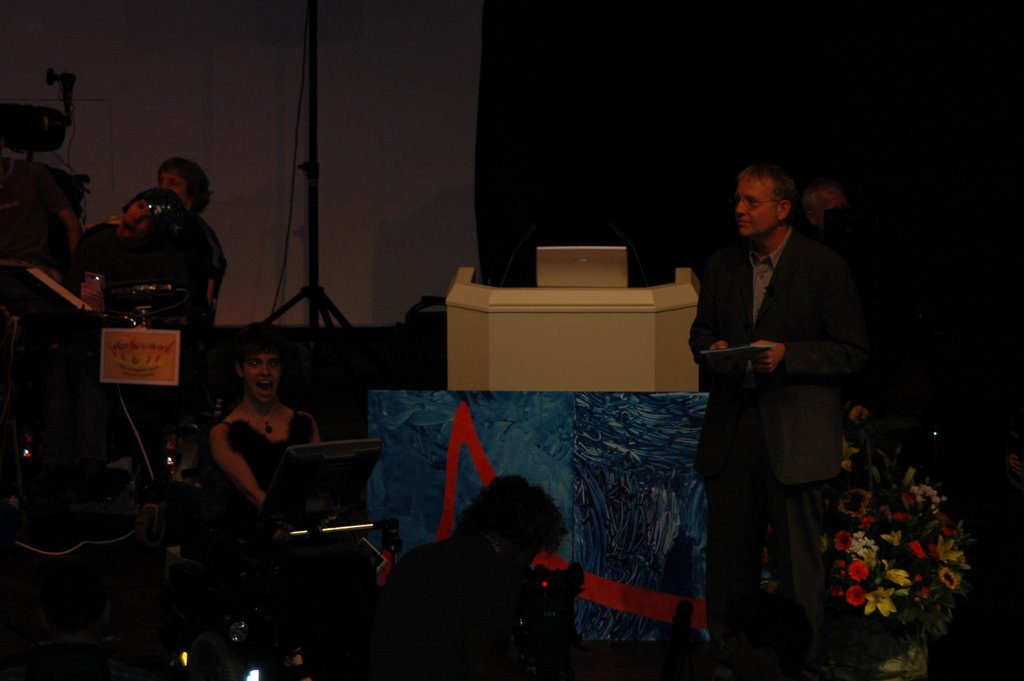



Tuesday, August 01, 2006
You´ve got to want it
I have gone to many interesting seminars so far at my conference. I am trying to focus on practical sessions as well as hearing from those who either use AAC or are parents of people who use AAC. These perspectives are really useful to my work as a professional in the field. I have known for a while that when a client cannot communicate verbally, finding a method and having success with it can be tricky and time consuming.
There are so many factors that affect the successful communication of AAC users. First, and very importantly, are the perceptions and comfort level of their communication partners. If the partners do not respond to subtle (or not so subtle) attempts to communicate, the system will fail (usually leading to frustration or passiveness). When the partners are afraid or uncomfortable with the technology that my clients depend on to communicate, the user´s views of the system change. For example, in a previous job, I worked with some clients who were learning to have a conversation. However, when they asked some people who worked at their school a question to start the conversation, the adult just stood there frozen. The clients kept trying but eventually gave up since they weren´t getting a reaction from their partner. After a while, the adult´s perceptions of the client as a competent communicator changed as did their own comfort interacting this way. Therefore, the client became more competent as a communicator.
Today I went to a session hosted by a parent. She has a daughter who is learning to use a high tech device (computer with touchscreen). The daughter "plays" with the device often but that is OK. That is a language stage that children go through. However, many people do not understand this and think that a client has to be successful as soon as they get the device. I also went to a lecture presented by a woman with cerebral palsy. She has her PhD and is a professor in the U.S. but grew up in South Korea. She talked about her family and the importance of her parents advocating for her. At one point, she started to cry because the subject was so emotional for her. She was talking about her son and a conversation with him about her disability. When she was crying, her son brought her a tissue on stage. I think most people in the audience teared up. It was amazing to hear this woman´s story. She was the first person with a disability from South Korea to get a PhD. She was one of the first included in mainstream education.
Whenever I go to presentations about AAC, especially those by AAC users, I am struck with a few thoughts. One, we are incredibly lucky when we can communicate through speech. Two, people with severe speech and language impairments have to fight and struggle to get what they need. It takes them so much effort to communicate. In other words, they have to want it. Badly. Their desire to communicate also hits home just how basic of human needs connection and communication are.
There are so many factors that affect the successful communication of AAC users. First, and very importantly, are the perceptions and comfort level of their communication partners. If the partners do not respond to subtle (or not so subtle) attempts to communicate, the system will fail (usually leading to frustration or passiveness). When the partners are afraid or uncomfortable with the technology that my clients depend on to communicate, the user´s views of the system change. For example, in a previous job, I worked with some clients who were learning to have a conversation. However, when they asked some people who worked at their school a question to start the conversation, the adult just stood there frozen. The clients kept trying but eventually gave up since they weren´t getting a reaction from their partner. After a while, the adult´s perceptions of the client as a competent communicator changed as did their own comfort interacting this way. Therefore, the client became more competent as a communicator.
Today I went to a session hosted by a parent. She has a daughter who is learning to use a high tech device (computer with touchscreen). The daughter "plays" with the device often but that is OK. That is a language stage that children go through. However, many people do not understand this and think that a client has to be successful as soon as they get the device. I also went to a lecture presented by a woman with cerebral palsy. She has her PhD and is a professor in the U.S. but grew up in South Korea. She talked about her family and the importance of her parents advocating for her. At one point, she started to cry because the subject was so emotional for her. She was talking about her son and a conversation with him about her disability. When she was crying, her son brought her a tissue on stage. I think most people in the audience teared up. It was amazing to hear this woman´s story. She was the first person with a disability from South Korea to get a PhD. She was one of the first included in mainstream education.
Whenever I go to presentations about AAC, especially those by AAC users, I am struck with a few thoughts. One, we are incredibly lucky when we can communicate through speech. Two, people with severe speech and language impairments have to fight and struggle to get what they need. It takes them so much effort to communicate. In other words, they have to want it. Badly. Their desire to communicate also hits home just how basic of human needs connection and communication are.
Monday, July 31, 2006
ISAAC, day one
Yesterday I made my first trip to a foreign speaking country alone! I flew to Duesseldorf Germany in order to go to the International Society for Augmentative/Alternative Communication (AAC) biannual conference. It has been interesting so far.
This morning there was an opening ceremony with some AAC users performing. They had a band and a black light show. I took a few pictures which I will post when I get back from my trip. It was really nice to see a variety of people of many ages performing together. Some needed help, some didn't. And they got to show off a more artistic side of themselves. The band was really interesting because the clients were using a lot of alternative access methods such as head pointers (they were a hat of sorts with a stick attached and use the stick to hit button/keys. One client used a pencil that she could grip and hold onto to play the keyboard. One guy also had really good rhythm and was dancing to the music as the performed.
The black light show was also really interesting. It was set to music and the performers used ribbons that showed up in the light to do an artistic performance. The pictures turned out really well but I can't post them until I get back. :(
The people here are also friendly. I hear a lot of American accents but others, too. The conference is far more laid back and practical in comparison to many that I have gone to. Tomorrow I get to go on a dinner cruise that was part of the conference fee! I also get transport as part of the conference fee, which is nice since it was 8.25 Euro from the main train station to the conference!
This morning there was an opening ceremony with some AAC users performing. They had a band and a black light show. I took a few pictures which I will post when I get back from my trip. It was really nice to see a variety of people of many ages performing together. Some needed help, some didn't. And they got to show off a more artistic side of themselves. The band was really interesting because the clients were using a lot of alternative access methods such as head pointers (they were a hat of sorts with a stick attached and use the stick to hit button/keys. One client used a pencil that she could grip and hold onto to play the keyboard. One guy also had really good rhythm and was dancing to the music as the performed.
The black light show was also really interesting. It was set to music and the performers used ribbons that showed up in the light to do an artistic performance. The pictures turned out really well but I can't post them until I get back. :(
The people here are also friendly. I hear a lot of American accents but others, too. The conference is far more laid back and practical in comparison to many that I have gone to. Tomorrow I get to go on a dinner cruise that was part of the conference fee! I also get transport as part of the conference fee, which is nice since it was 8.25 Euro from the main train station to the conference!
Tuesday, July 25, 2006
Challenges of Parenthood
When working with the children, a speech therapist has contact with schools and families. Most children have some type of annual meeting to discuss the previous year, progress and goals for the next year. In the U.S., this is called an Individual Education Plan (IEP). Some children in Ireland have these as well. During IEPs, parents sometimes talk about how things are going at home.
It is these times that I am struck with just how difficult raising a child with special needs can be. Some families use respite services. Respite is different in different areas but the idea is the same: give the families a break and some time to themselves. Raising children is a 24/7 job. Raising a child with a disability can be an incredibly intense 24/7 job. As typically developing children age, parenting can sometimes be less intense as the children can play by themselves. However, some children with special needs need 24/7 monitoring for their safety or their health. Parents don't get a break. The goal of respite is to try to alleviate some of that stress. However, my experiences as a respite worker were that the families never got as much as they needed, if the respite agency could find someone suitable to work with the family (respite workers got very low pay for the intensity of the job and there was really high turn over of staff in the areas I worked).
Other parents have talked about how difficult it is to take their children out in the community. They would love to be able to go grocery shopping with their child. As a respite worker, some families that I worked with never took a vacation. It just would have been too difficult.
What strikes me most working with children is the dedication of parents. Like the vast majority of parents, they want what is best for their children. However, they frequently don't know what that is or how to get it. What is best for their children also may not be available to them. They have professionals telling them to do this and that at home. They have other children asking questions about their sibling with a disability or acting out because they are jealous of the attention the child with the disability gets. Some parents can't sleep through the night because they have to check on their child. There is a whole additional set of worries. There are different joys. It is a different journey.
It is these times that I am struck with just how difficult raising a child with special needs can be. Some families use respite services. Respite is different in different areas but the idea is the same: give the families a break and some time to themselves. Raising children is a 24/7 job. Raising a child with a disability can be an incredibly intense 24/7 job. As typically developing children age, parenting can sometimes be less intense as the children can play by themselves. However, some children with special needs need 24/7 monitoring for their safety or their health. Parents don't get a break. The goal of respite is to try to alleviate some of that stress. However, my experiences as a respite worker were that the families never got as much as they needed, if the respite agency could find someone suitable to work with the family (respite workers got very low pay for the intensity of the job and there was really high turn over of staff in the areas I worked).
Other parents have talked about how difficult it is to take their children out in the community. They would love to be able to go grocery shopping with their child. As a respite worker, some families that I worked with never took a vacation. It just would have been too difficult.
What strikes me most working with children is the dedication of parents. Like the vast majority of parents, they want what is best for their children. However, they frequently don't know what that is or how to get it. What is best for their children also may not be available to them. They have professionals telling them to do this and that at home. They have other children asking questions about their sibling with a disability or acting out because they are jealous of the attention the child with the disability gets. Some parents can't sleep through the night because they have to check on their child. There is a whole additional set of worries. There are different joys. It is a different journey.
Thursday, June 22, 2006
School's Out
The end of the school year always has special meaning for me. As a child, I was always sad because I loved school. Since I have started working, it is a time of relief. Even if I don't work in a school, I am somehow still clued into the school cycle. Schools are somehow comfortable for me. I think because I have spent most of my career working in them, they are familiar. I know what to expect because there is a general school culture and norms are similar in every one that I have worked in. Yes, every school is different, but they still tend to be familiar and comfortable.
In many ways, special education schools that I have worked in are the same. They are more laid back than regular education schools. There can have a more functional curriculum. You can spend an entire school year trying to get behavior under control and have that be a successful year. You can take the children out to the shops for a reward and it is a functional educational experience. The children overall also seem pretty happy. They are friendly and happy to see me when I come in the room. In a general education classroom, kids start to dread you coming to get them/coming in the room at some point.
Schools can also be challenging. I think you have to show investment and understanding in the children, school, and staff before teachers will really willingly work with you. Some staff may have a long warm up period. In a previous job, it took 3 years before I felt like I was truly accepted by the teachers and teaching assistants. Teachers have so many people telling them how to do their job and not always the best training to do it. Teachers really do try hard to do what is best for all of the children but it is really difficult. If they have a class of 25, there are 25 individual needs that they need to try to meet while teaching the standard curriculum. When you add in a child with special needs, it really throws off the balance of the classroom. It can be quite successful, especially when the child has the proper supports, whatever they may be for that child. I think it takes a lot of commitment on the part of the school, teachers, and parents in order to make integration/inclusion work. It also takes funding. If teachers had fewer children in the class if they had a child with special needs, I think that it would help. Then there wouldn't be so many demands placed on the teacher. Teachers also need more training in special education.
In many ways, special education schools that I have worked in are the same. They are more laid back than regular education schools. There can have a more functional curriculum. You can spend an entire school year trying to get behavior under control and have that be a successful year. You can take the children out to the shops for a reward and it is a functional educational experience. The children overall also seem pretty happy. They are friendly and happy to see me when I come in the room. In a general education classroom, kids start to dread you coming to get them/coming in the room at some point.
Schools can also be challenging. I think you have to show investment and understanding in the children, school, and staff before teachers will really willingly work with you. Some staff may have a long warm up period. In a previous job, it took 3 years before I felt like I was truly accepted by the teachers and teaching assistants. Teachers have so many people telling them how to do their job and not always the best training to do it. Teachers really do try hard to do what is best for all of the children but it is really difficult. If they have a class of 25, there are 25 individual needs that they need to try to meet while teaching the standard curriculum. When you add in a child with special needs, it really throws off the balance of the classroom. It can be quite successful, especially when the child has the proper supports, whatever they may be for that child. I think it takes a lot of commitment on the part of the school, teachers, and parents in order to make integration/inclusion work. It also takes funding. If teachers had fewer children in the class if they had a child with special needs, I think that it would help. Then there wouldn't be so many demands placed on the teacher. Teachers also need more training in special education.
Wednesday, May 17, 2006
Why am I here?
Periodically, I ask myself why I moved to Dublin. I know that I moved here to try to make a difference. My reason for becoming a speech therapist was also to make my little corner of the world better. Every now and then, I ask myself if I have helped make my clients' lives better and if I am helping to better the field. Today I got to answer yes. I see progress and change. And that is why I am here.
Will my child talk?
When I assess children, I like to meet with the parents to go over my report. Hopefully the results aren't shocking. However, it is extremely difficult to tell parents that their child is functioning at such and such level. I usually don't say what age the child is functioning like in my reports unless I think a) the parent needs to see the results in that way, b) the report is being sent to another agency and they need numbers, c) the numbers are "good enough" that I don't think it will negatively affect the parents.
There is one question that is always hard to answer: "will my child talk?" I hate that question. I don't have a crystal ball. I don't know if or when the child will talk. I can tell statistics and all that but sometimes I feel like I am popping or inflating the balloon of hope when I do that. I am not a miracle worker even though some parents are looking for a miracle.
I think the question "will my child talk?" is another question: will my child be OK? When children can't communicate, people judge them a certain way and make assumptions about how "smart" they are. Children who are very socially competent are judged to be "smarter" than those who have social skill difficulties. It is really unfortunate. I suppose, what else do people have to judge on?
There is one question that is always hard to answer: "will my child talk?" I hate that question. I don't have a crystal ball. I don't know if or when the child will talk. I can tell statistics and all that but sometimes I feel like I am popping or inflating the balloon of hope when I do that. I am not a miracle worker even though some parents are looking for a miracle.
I think the question "will my child talk?" is another question: will my child be OK? When children can't communicate, people judge them a certain way and make assumptions about how "smart" they are. Children who are very socially competent are judged to be "smarter" than those who have social skill difficulties. It is really unfortunate. I suppose, what else do people have to judge on?
Subscribe to:
Posts (Atom)


